
“Contrariwise,” continued Tweedledee, “if it was so, it might be; and if it were so, it would be; but as it isn’t, it ain’t. That’s logic.” Lewis Carroll, Through the Looking Glass
This logic puzzle reportedly appeared in Omni Magazine decades ago, and it’s astoundingly “impossible” because it seems to lack enough information for a solution. This deceptively simple puzzle captures the essence of the exploration of non-obvious implications; the kind of untimed reflection that allows for deep reasoning. It also unfolds in a charming, diplomatic setting where imagination gives way to cold, symmetrical logic, rich with abstract beauty!
The Diplomatic Puzzle: A Handshake Puzzle
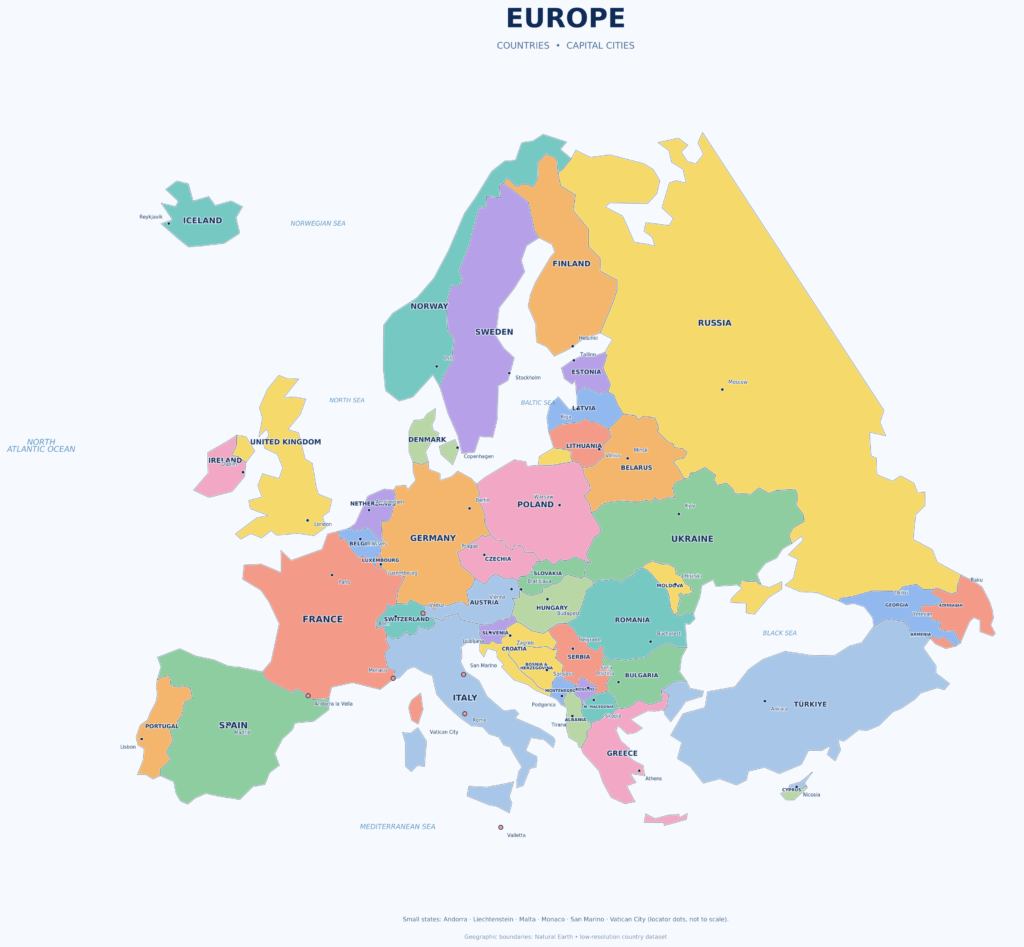
During an International Summit, each of the Commissioners and the accompanying Delegates from the 27 member countries took part in the inaugural session. There were 54 people in all: two from each country (one Commissioner and one Delegate). Before the start of the session, some of the participants shook hands with each other, although no Commissioner shook hands with his/her Delegate, and no two people shook hands more than once. After the session, the Commissioner from Germany asked everybody how many times they had shaken hands. All the participants (excluding the German Commissioner) answered, and the numbers they gave were all different. How many times did the German Commissioner shake hands?1
Hint
Reveal Hint
How many handshakes can each person have? Consider the case of the person who shook nobody’s hand.
Solution
Reveal solution
First of all, we can determine the number of all possible handshake counts each person can have. Each participant cannot shake hands with themselves, and each one of them did not shake hands with his/her country’s partner. Therefore, the maximum number of handshakes a participant may make is . As a result, the range of all possible numbers of handshakes for any given person goes from to . Note that each person, besides the German Commissioner, reported a different number (i.e., a distinct integer), and since handshake counts must be integers between and , the only possible way for this to occur is if the people’s reported counts are in one-to-one correspondence with the set , which has exactly distinct elements.
Now, consider what occurs whenever a given person shakes hands a specific number of times. For instance, suppose a person shook hands times; then their corresponding partner from the same country must have shaken hands times since the person with handshakes shook hands with nobody, and their partner can neither shake hands with themselves nor can they shake hands with their partner who shook none.
Why, you may ask, does this follow? Well, we know that someone reported a count of , and we also know that someone must report a count of . Who could possibly report ? Only the person who shook hands with every participant they were allowed to — namely, the partner of the person who shook hands with nobody.
If this person had shaken hands with fewer than people, then no one else could report that number. Any other person attempting it could shake hands with, at most, people (they cannot shake hands with themselves, the person who shook hands with nobody, or their own partner). But must appear somewhere among the answers, which is a contradiction, and thus impossible!
The same reasoning shows that the person who shook hand must be paired with the person who shook , the person who shook hands must be paired with the person who shook , and so forth. We may express this situation as a set of ordered pairs,
We are now on the threshold of a solution because the same piece of information that led us to deduce the number of possible values of handshake counts is the one on which our finale depends (though, to be sure, a very diplomatic one). Observe that among the possible ordered pairs there are pairs , where , which indeed correspond to the given responses. Consequently, the only pair left, in which both numbers are the same, must correspond to the German Delegate and must be paired with the German Commissioner, that is, . Hence, the German Commissioner shook hands times!
By the same reasoning, if, under the same conditions, the Summit has other partners, the answers would be the numbers . Then, we may deduce the country partners would be the pairs and , and , and so on, with the unpaired answer of .2
References & Further Reading
- Omni IQ Test Problems. (n.d.). Compilation of puzzles attributed to OMNI Magazine. Retrieved from https://vdoc.pub/documents/omni-iq-test-problems-6qfkefa3hea0 ↩︎
- For additional presentations and solutions to this classic handshake problem, see Emma R. Hasson’s Math Puzzle: How Many Handshakes?, published in Scientific American, and Presh Talwalkar’s The “Impossible” Handshake Logic Puzzle: A Martin Gardner Classic (2017). The latter offers both a graphical interpretation and a generalization of the problem to an arbitrary number of married couples. ↩︎