
“Mathematics is the art of giving the same name to different things.”— Henri Poincaré, The Future of Mathematics (1908).
Introduction
Now and then, a social media post divides the internet by suggesting that, in some number systems, certain equations are true while in others they are not, as evidence that the laws of arithmetic vary by context or even by culture. But, of course, the same old arithmetic lies behind every number system! These systems are simply different ways of representing the same numbers, like languages: there is no contradiction between French and English; both are valid ways to conceptualize and communicate the facts of the world around us.
Two plus three is always five, regardless of the number base in which we choose to express it. What changes is the notation: in base five, for instance, the sum is written , while in base four it is written The underlying quantity remains the same, and we can translate exactly from one positional system to another. Yet the choice of representation is more than a matter of appearance. Some number systems make certain patterns easier to recognize, calculations more convenient to perform, or mathematical relationships more readily accessible. A change in notation can therefore become a change in perspective—and sometimes, that is precisely what a problem needs.
Consider, for example, the following puzzle, which is a peculiar variation on the familiar weighing puzzle. You might start playing around, maybe even solve it by trial and error, but can you find a number system that makes this problem a lot easier?
A Weighing Puzzle
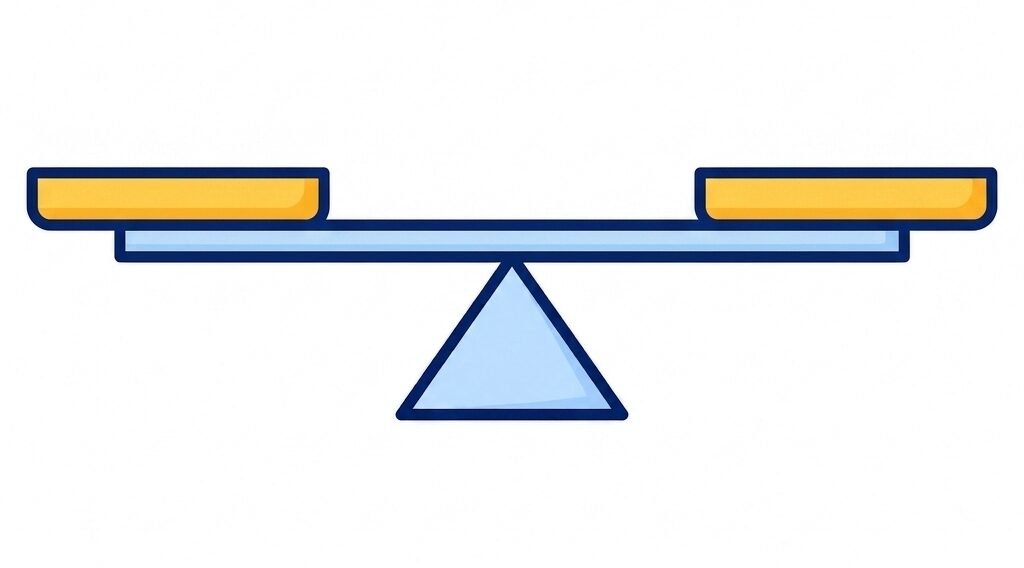
The illustration below shows a simple scale for weighing objects. The scale consists of a lever resting on a fulcrum with weighing pans at each end of the lever, equidistant from the fulcrum. Suppose the objects to be weighed may range in weight from pound to pounds at one-pound intervals: After placing one such object on either of the two weighing pans, one or more precalibrated weights are then placed in either or both pans until balance is achieved, thus determining the weight of the object. If the relative positions of the lever, fulcrum, and pans may not be changed, and if one may not add to the initial set of precalibrated weights, what is the minimum number of such precalibrated weights that would be sufficient to bring into balance any of these one hundred objects?1
Hint
Reveal Hint
Don’t think of each weight as simply being used or unused. Since a weight can be placed on either pan or left aside, it has three possible states. Can you translate these three possibilities into numerical values and identify a number system that makes use of them?
Solution
Reveal solution
On a balance scale, where you may put each precalibrated weight (referred to as “weights” hereafter) on the same pan as the object (to subtract) or on the opposite pan (to add), each weight has three “states”: “not used“, “placed with the object”, or “placed against the object“. Assume there are such weights, where . Since each weight can be in three possible states, by the multiplication principle, there are possible combinations of weight placements. Accordingly, we can reframe this problem as one of balanced ternary representation by assigning values from the set to each weight state:
- if the weight is placed with the object (say, on the right pan)
- if the weight is not used (on neither pan)
- if the weight is placed against the object (say, on the left pan)
The signs depend on which side of the scale we choose as positive, but the essential idea is that a weight can either add to or subtract from the object’s weight. For example, suppose the available weights are and pounds. Can we weigh an object of pounds? Yes! Put the -pound weight opposite the object and the -pound weight alongside it:
Furthermore, the weight of any object to be weighed may be written as a unique sum of powers of . Thus, for weights , every combination yields a total value:
Each such signed sum gives a unique integer from
That’s because the maximum value occurs when all digits are and the minimum when all digits are . Both of those give geometric series of the form:
Thus, the range of possible integer weight coverage goes from , inclusive. That is
distinct integer values—exactly as many as there are combinations! On the other hand, to cover any integer weight from up to some positive bound , we need
Note that this is completely equivalent to putting all of the weights on one pan, giving you the maximum amount of measurable weight since it is the maximum amount one could “add” against the object (or the maximum one could “subtract” if one moved them all to the object’s side, with the opposite sign; in any case, it is the maximum absolute value).
Setting gives,
Hence, is both necessary and sufficient since
Therefore, only precalibrated weights are necessary and sufficient to weigh any integer weight between and . Use weights of pounds, the powers of three that can represent every integer from through as a balanced ternary number with no more than five digits. We can generalize this result by applying the log and the ceiling functions to calculate the exponent directly. Then, the minimum number of weights needed to weigh every integer from 1 through is
How it works in practice
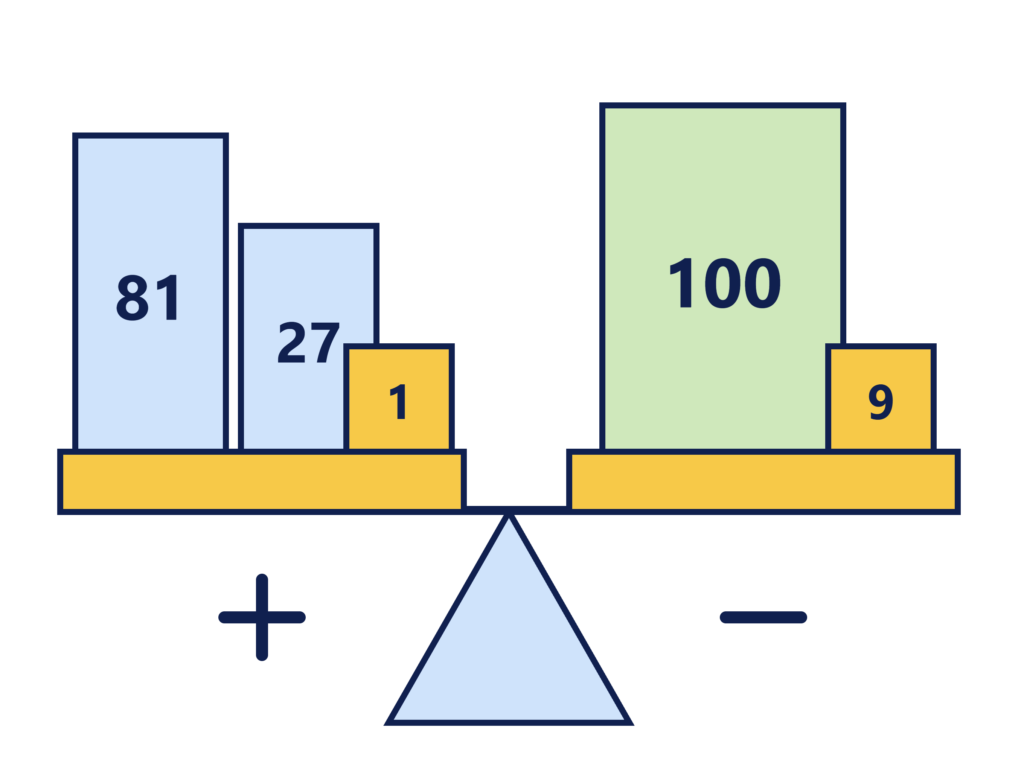
Suppose you want to weigh a object. Place the object on the right pan. Then convert the decimal number into a ternary number. To convert 100 into balanced ternary, repeatedly divide by , using the remainders as digits. Whenever a remainder is 2, replace it with -1 and increase the quotient by 1. Continuing this process gives , read in reverse order. Thus . Observe what this means: you need to place the , , and weights on the left pan (against the object), and you need to place the weight on the right pan (with the object). Then the pans balance, confirming the object weighs . This scheme works for any of the given objects you wish to weigh (see the image above).
Further Exploration: What if we change the rules?
In the original puzzle, you could place an object on either pan. But suppose we add a new constraint: weights can only be placed on the pan opposite the object.
What would be the fewest number of precalibrated weights necessary to bring into balance any of the 100 objects?
Hint
Reveal Hint
What number system, that underlies the logic of modern electronic computers, is ideal for two-state values?
Solution
Reveal solution
This time you can either use a weight or not. Therefore, the two “states” are: “used” and “unused“. Assume there are such weights, where . Since each weight can be in two possible states, by the multiplication principle, there are possible combinations of weight placements. Hence, we can reframe this problem as one of binary representation by assigning values from the set to each weight state:
- if the weight is not used
- if the weight is used
Moreover, the weight of any object to be weighed may be written as a unique sum of powers of . Thus, for weights , every combination yields a total value:
Each such sum gives a unique integer from
That’s because the maximum value occurs when all digits are and the minimum when all digits are 0. Both of which give geometric series of the form:
Thus, the range of possible integer weight coverage goes from , inclusive. That is
distinct integer values—exactly as many as there are combinations! On the other hand, to cover any integer weight from up to some upper bound , we need
Note that this is completely equivalent to putting all of the weights on one pan, giving you the maximum amount of measurable weight since it is the maximum amount one could add. Solving for gives
Setting gives,
Therefore, only precalibrated weights are necessary and sufficient to weigh any integer weight between and . Use weights of pounds, the powers of three that can represent every integer from through as a balanced ternary number with no more than seven digits; a few more than using ternary representation, so we might say that the first method is more efficient.
Now it is your turn to experiment! Use the calculator below to convert different whole numbers into binary. Enter a number or click the binary digits to change them, and watch how the corresponding powers of two add up to the result. Remember that every digit represents a weight placed on the pan opposite the object, while every represents an unused weight.
Can you find the combination of weights needed to balance any object weighing between and pounds?
A Final Challenge: The Unknown Object
Now, suppose we go back to the original puzzle, so we are allowed to place the objects on either pan again, and you wish to determine the weight of a single object known to have a weight in the given range (i.e., from pound to pounds at one-pound intervals), what is the minimum number of weights required? Which weights would be used?2
Hint
Reveal Hint
Note that you don’t have to bring into balance all the objects; all that is required is to determine the unknown weight.
Solution
Reveal solution
The minimum number of weights needed to weigh 100 objects with weight , assuming that the weights may be placed on either pan, is still five: (they represent doublings of powers of successive powers of 3). Each weight can be placed on either pan or left unused. Consequently, every signed difference has the form
By the result of the first problem, the expression can represent every integer from to . Therefore, these weights can produce every even number from 2 to 242. In particular, we can achieve exact balance for every even number of pounds from through . What about objects weighing an odd number of pounds? Since the weights available are all even, exact equilibrium is impossible. However, we can determine their weights by comparing them with the adjacent even numbers.
For example, suppose an object weighs pounds. We can establish that it weighs less than pounds and more than pounds:
- To compare against pounds, place the object and the -pound weight on one pan, and the -, -, and -pound weights on the other. If the object is lighter, then it must weigh less than pounds.
- To compare against pounds, place the object and the -pound weight on one pan, and the – and -pound weights on the other. If the object is heavier, then it must weigh more than pounds.
This can be generalized as follows: Suppose we have calibrated weights. Each can be placed on the left pan, the right pan, or left unused, giving possible configurations. Let denote the number of distinct positive weight differences that these configurations can produce.
Because exchanging the pans reverses the sign of every difference, the configurations come in pairs, except for those producing zero. Thus,
Now arrange the distinct comparison values in increasing order:
These comparisons can distinguish at most different possibilities for the object’s weight: equality with one of the values, or lying in one of the intervals between them (including the two outer intervals). Consequently,
It follows from this that
Let us know pick our weights in such way as to show that this lower bound can be achieved. As before, let us choose the weights
Therefore, every combination yields a total value:
Each such signed sum gives a unique even integer from
Indeed, dividing the weights by two gives the ordinary powers of three, whose signed combinations represent every integer in the balanced ternary system. As a result, we can use the available weights to compare an unknown object against any even amount in the sequence
These comparison values allow us to distinguish every integer from through :
- An object weighing an even number can be identified by achieving exact equilibrium.
- An object weighing an odd number lies strictly between two consecutive even comparison values.
- At the endpoints, the known range supplies the missing inequality.
Thus, weights suffice to identify any integral weight up to . Since we have already established that fewer than weights cannot suffice, our construction is optimal. Hence, the minimum number of weights needed to determine the weight of a single object known to have a weight in the range from 1 through is
Beyond the 100 range
The answer was identical to the first case in which we were asked to balance each and every object, but we discovered that the weights used were different and the general formula was also different. What then would be the first time the minimum number of weights differs, assuming we have more than one hundred objects?
References & Further Reading
- Adapted from Hoeflin, R. K. (1985, April). Problem 38 in The Mega Test. Omni, 7(4), p. 132. ↩︎
- This problem is a slight variation of a balance-scale problem posed by Martin Gardner in Martin Gardner’s Sixth Book of Mathematical Diversions from Scientific American (Chicago: University of Chicago Press, 1983; originally published in 1971), 107. Gardner’s original problem asks for the minimum number of weights needed to determine the weight of an object known to weigh an integral number of pounds between 1 and 27, assuming that the weights may be placed on either pan. The present version retains the original setup but extends the range to 1–100 pounds. ↩︎