Strange as it may sound, the power of mathematics rests on its evasion of all unnecessary thought and on its wonderful saving of mental operations. —Ernst Mach, 1838–1916
Some geometric puzzles look deceptively simple. Draw a few curves or straight lines, let them intersect as much as possible, and count the regions they create. However, once we impose a restriction, once we ask for the maximum possible number of regions, things begin to look a bit dizzy.
Here, once again, we meet a Hoeflinian puzzle, but this time it comes straight from the Titan Test, which was supposed to be even harder than the Mega Test. In another post, we solved a very similar puzzle in nature, involving three mutually intersecting rectangles. That problem already showed us that counting regions is not quite as straightforward as it might first appear: maximizing areas requires a special kind of topological thinking, a bit different than what one is accustomed to in a typical geometric problem.
The shapes themselves are almost incidental. What really matters is the structure produced by their intersections: which curves meet, where they meet, how those intersections divide the plane, and which resulting regions satisfy the conditions of the problem.
This is what makes these puzzles so interesting. Our usual geometric instincts tend to focus on lengths, angles, areas, and other quantities that can be measured. Here, however, we are being asked to look at a figure in a rather different way. We have to think about its topological structure—about connectivity, boundaries, intersections, and subdivisions—while still exploiting the geometric freedom available to us and, interestingly enough, we leverage our understanding of the Euclidean axioms all the time. The present problem takes this idea a step further.
Five Shapes, Countless Possibilities
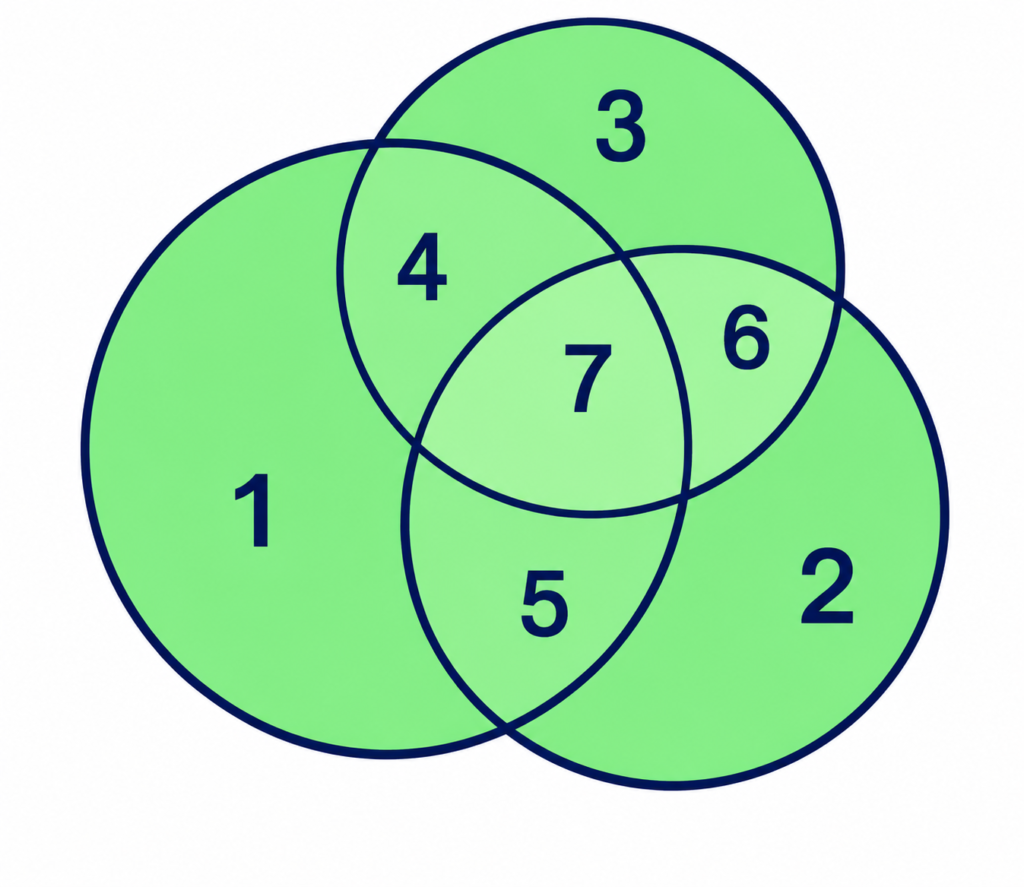
Three mutually intersecting circles (as illustrated below) can yield a maximum of seven completely bounded areas, counting only areas that are not further subdivided. What is the maximum number of completely bounded areas not further subdivided that can be obtained using three mutually intersecting circles plus two triangles?1
Hint
Reveal Hint
Instead of trying to draw the circles first and then fitting in the triangles, try drawing the triangles first, adding them one by one to observe how the number of regions increases to obtain a concrete geometric construction.
Solution
Reveal solution
We begin with the fact that three circles can yield up to seven completely bounded areas. Then, let us draw the first triangle and see by how much the number of bounded regions/areas increases. To maximize the number of regions, all of the triangles are assumed to be in general position2. A triangle may intersect each circle in up to points (each of its three sides can cross the circle twice, as each side “enters” the circle and “exits” it).
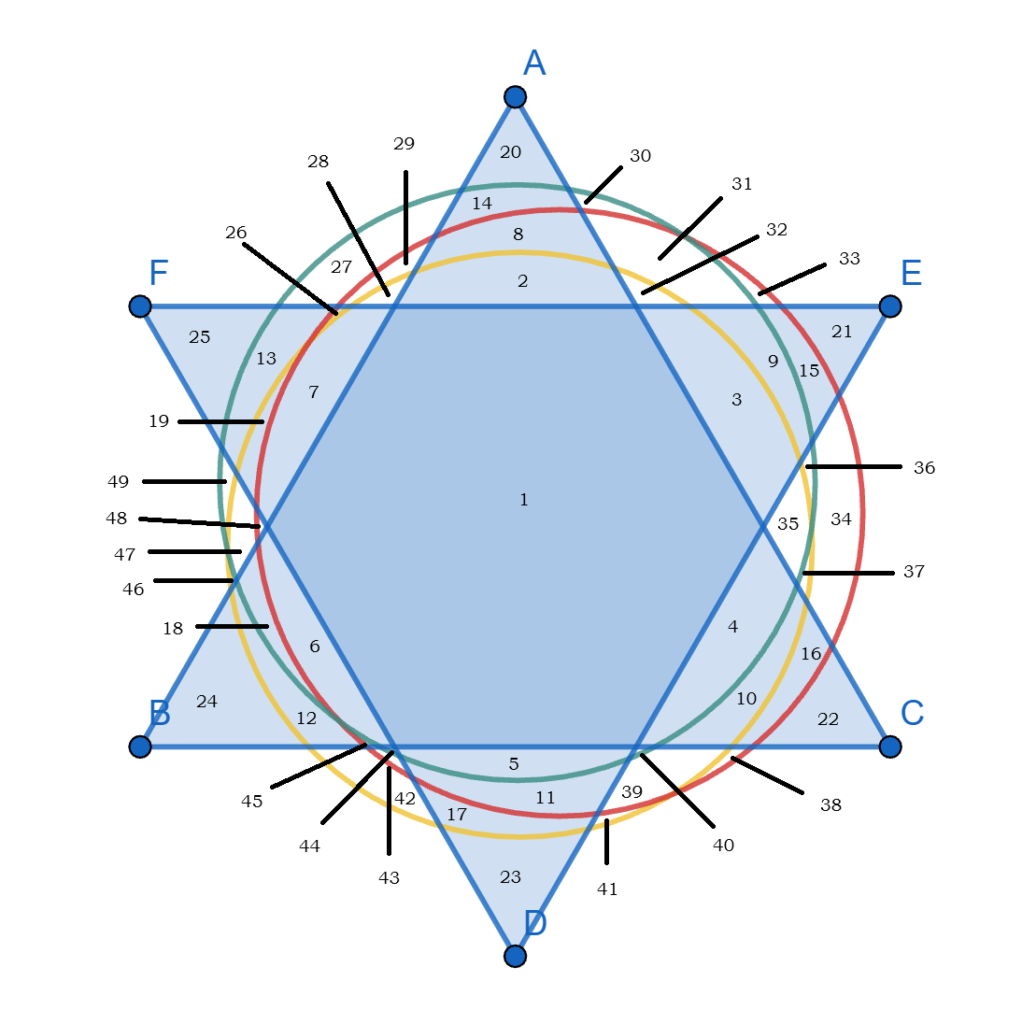
The first triangle, therefore, intersects each of the circles in points; these points divide the triangle into arcs, i.e., connected paths along its boundary between two consecutive intersection points. Each arc divides one of the regions formed by the given circles in two. Consequently, the number of new bounded regions so far is . By similar reasoning, the second triangle intersects the circles in points and the first triangle in points (each side of one triangle “enters” and “exits” another triangle). As a result, the new total number of bounded regions is , the maximum possible number of regions. Such a set of circles and triangles is nonempty, as illustrated below3
We may generalize the preceding argument to an number of triangles as follows: Suppose that of the triangles have already been drawn in the plane such that they intersect each other in general position and they intersect the three circles also in general position; let us draw the triangle and see by how much it increases the number of bounded regions/areas into which the plane is divided. The triangle intersects each of the triangles in points; these points divide the boundary of the triangle into arcs. Each arcs divides the regions formed by the first triangles into two parts.
Moreover, the triangle intersects the three circles in points, further dividing this triangle into additional arcs, each of which divides one of the regions formed by the given circles in two. Hence, the total number of newly added bounded regions is . Since we begin with seven regions, the total number of parts after drawing the triangle is
If we substitute for , we obtain
Which is the same answer. You can check that the formula agrees with the case as calculated in the first argument.
Making Wider Connections
Suppose we use only circles instead. What is the maximum number of regions (bounded or unbounded) that circles can form in the plane? Can you discover a general formula and prove that no other arrangement can produce more regions? What would this result tell us about the formation of Venn diagrams?
Notes & References
Technical Notes on the Solution & References
- From Hoeflin, R. K. (1990, April). Problem 34 in the Titan Test. Retrieved September 7, from http://miyaguchi.4sigma.org/hoeflin/titan/titan.html ↩︎
- That is, if no two of them are tangent, no two sides are parallel or coincident, and none of them lies entirely within or outside another, no three of them are concurrent. In addition, for any set of intersecting triangle and circle, no two figures is tangent or lies entirely within or outside either figure, and no three of figures are concurrent. Finally, every two circle have exactly two poins in common. ↩︎
- In principle, such sets of figures always exist. It is possible to draw an infinite number of triangles and three circles with the desired properties. For instance, construct intersecting equilateral triangles of the same size by fixing a base triangle (the unrotated triangle), then superimpose congruent triangles with the base triangle, and successively rotate each of these about their common center (i.e., the center of the base triangle) by increasing non-multiples of . Finally, draw three circles such that each intersects each triangle in points and meets the others in points, and no two circles intersect at the same point in a given triangle. ↩︎