A mathematician is a machine for turning coffee into theorems —Paul Ërdos, 1913–1996
Introduction
At first glance, counting the regions formed by overlapping shapes seems like a simple drawing exercise. But geometry often conceals surprising complexity: a small change in the arrangement of a few familiar shapes can dramatically increase the number of regions they create. A familiar case would be attempting to find the maximum number of regions in which the plane can be divided by circles; it turns out that the answer implies the impossibility of having a four-circle or more Venn diagram!
These deceptively simple questions lead to a broader problem in combinatorial geometry: how does the number of regions grow as we add more figures? By examining how their boundaries intersect, we can turn a geometric puzzle into a general counting argument. The reader may note that as the complexity of the shapes involved increases, this question becomes harder to answer.
This is illustrated by considering the following puzzle, which is the two-dimensional counterpart of a much more difficult 3D open problem1. Try solving the puzzle before reading the solution. As you work, remember that finding a configuration that achieves a particular number is not the same as proving that the number is the maximum.
The 3-Rectangle Puzzle
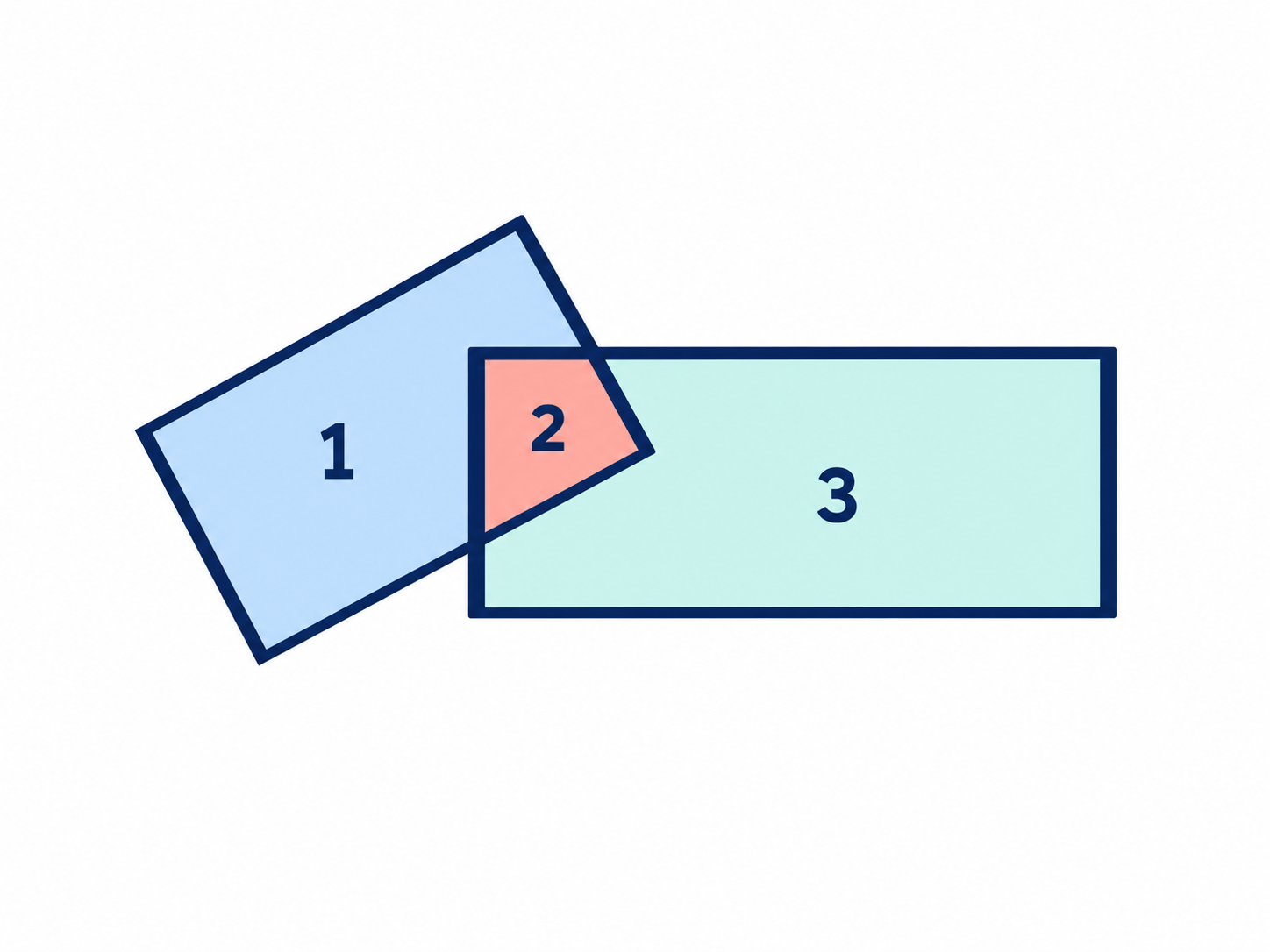
If three mutually intersecting rectangles are drawn on a flat surface, what is the maximum number of completely bounded areas that can thereby be formed, considering only the sides of the rectangles as bounds and counting only the areas that are not further subdivided? (The figure below illustrates two intersecting rectangles together with three completely bounded areas.)2
Hint
Reveal Hint
Rather than trying to count all the bounded regions in the final diagram at once, begin with a single rectangle and add the others one by one. How many new regions can each additional rectangle create?
Solution
Reveal solution
In the Cube-Slicing Puzzle article, we saw that the maximum number of areas into which the plane can be divided by lines is achieved if the lines are in general position (every two of them intersect, no two of them are parallel, and no three of them are concurrent), thereby maximizing the number of points of intersection. We will apply the same topological principle, but this time to the sides of the rectangles.3
rectangles will divide the flat surface into a maximum number of areas if any two rectangles intersect, that is, if no two of them are tangent, no two sides are parallel or coincident, and none of them lies entirely within or outside another, and no three of them are concurrent4. However, before plunging right into the induction, we shall prove that two rectangles can at most intersect in points.
We fix rectangles and . Each side (a straight segment) of is a straight segment crossing the convex polygon ; a straight segment can meet the boundary of a convex polygon in at most two points (enter and exit). Since has sides, the boundary of meets the boundary of in at most points. So any pair of rectangles contributes at most intersection points.
Now, suppose that of the rectangles have already been drawn in the plane; let us draw the rectangle and see by how much it increases the number of regions/areas into which the plane is divided. The rectangle intersects each of the rectangles in points; these points divide the boundary of the rectangle into arcs, each being a connected path along its boundary between two consecutive intersection points. Each of these arcs divides the regions formed by the first rectangles into two parts. Since one rectangle divides the plane into two regions, the total number of parts after drawing the rectangle is,
To obtain our final answer, we only need to substitute into our formula and subtract to account for the unbounded area, which is the complement of the union of all rectangle areas (i.e., “the area that does not belong to any rectangle”). Thus,
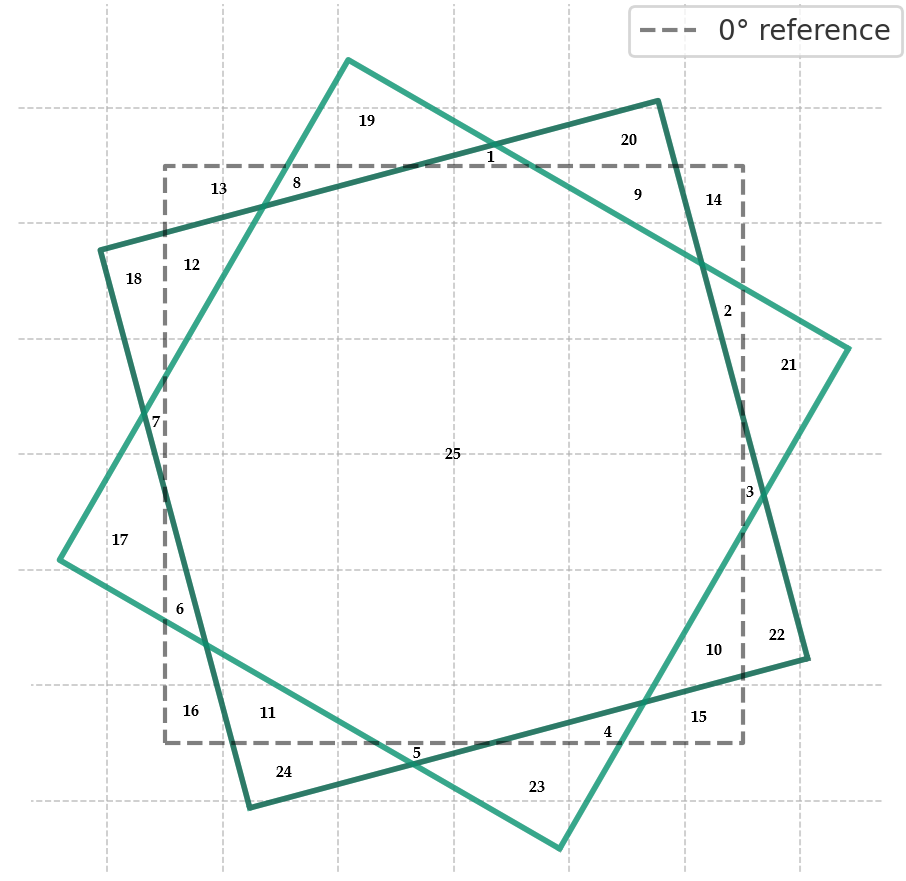
Now you can do the same for an arbitrary number of rectangles! We see that this set, in particular, is nonempty, as shown below
Beyond Rectangles
The solution relies on the fact that the boundaries of two rectangles can intersect at as many as eight points. But is this principle unique to rectangles?
Suppose we replace every rectangle with a triangle. What is the maximum number of completely bounded regions that triangles can form in the plane? Can you discover a general formula and prove that no other arrangement can produce more regions?
Notes & References
Technical Notes on the Solution & References
- Weisstein, E. W. (2026, October 30). Cube 3-compound. In MathWorld—A Wolfram Web Resource. Wolfram Research. https://mathworld.wolfram.com/Cube3-Compound.html ↩︎
- Adapted from Hoeflin, R. K. (1985, April). Problem 28 in The Mega Test. Omni, 7(4), p. 129. ↩︎
- Although the problem could technically be interpreted as drawing the rectangles on a finite flat surface, we will still get the same result because we are only counting areas whose sole bounds are the sides of the rectangles, discarding the complement of the union of all rectangles, regardless of whether this complement is finite or infinite. ↩︎
- Such sets of rectangles always exist; in fact, it is possible to draw infinitely many rectangles in the plane in such a way that any two of them intersect in points, but no three of them are concurrent. For example, construct intersecting rectangles of the same size by fixing a base rectangle (the unrotated rectangle), then superimpose congruent rectangles with the base rectangle, and successively rotate each of these about their common center (i.e., the center of the unrotated rectangle) by increasing non-multiples of (see Fig.2). This family clearly has the desired properties.
↩︎