“It is by logic that we prove, but by intuition that we discover.” — Henri Poincaré, 1908.
Introduction
The following puzzle bears a resemblance to some Moscow Mathematical Olympiad Problems1. I believe Hoeflin himself drew as much inspiration from Martin Gardner’s puzzles as from USSR Olympiad problems for the gifted. Although some of the Mega tests’ items are indeed known math results, there is some ingenuity in their presentation and in asking new questions based on prior formulated problems.
In other words, they may be seen as good follow-up questions to classical problems with known elementary solutions. At first glance, this problem mirrors the one discussed in the previous article, which seeks to determine the optimality of a spatial arrangement, with its peculiar culinary setting. Nonetheless, instead of asking for 3D space regions, it asks for the lines that unite the planes dividing space. However, it contains additional surprises I would not like to give away yet.
The Space Between the Dots Puzzle
Five dots are arranged in space so that no more than three at a time can have a single flat surface pass through them. If each group of three dots has a flat surface that passes through it and extends an infinite distance, what is the maximum number of different lines at which these surfaces may intersect one another? 2
Hint
Reveal Hint
Does every pair of intersecting planes form a distinct line?
Solution
Reveal Solution
Let be the points given. We begin by noting a very basic, nonetheless important fact: a plane is uniquely determined by points in three-dimensional space. Thus, the total number of planes determined by every group of dots is
Now, if these planes were in general position (i.e., no two planes are parallel, any three planes must intersect at exactly one point, and no four planes can have one point in common), the number of distinct lines at which they intersect would be
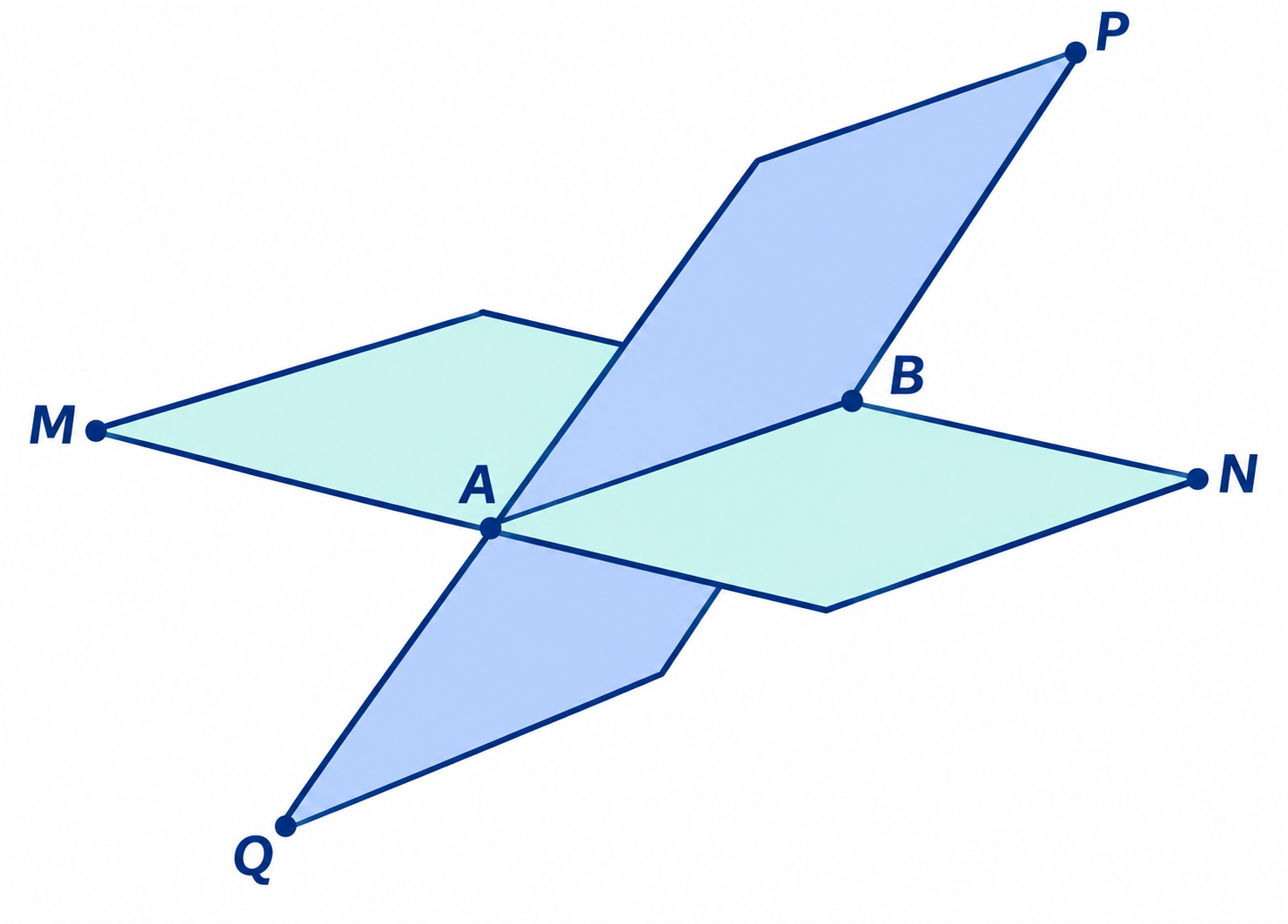
Since any pair of planes would determine a distinct line, thereby maximizing the number of lines. Nevertheless, it is given that for each set of three points, there is a plane that contains them. Let us investigate how this condition affects the ways in which the planes intersect. First of all, it implies that any pair of points must be contained in at least one line of intersection. Why?
Suppose two points lie in the same plane , say A and . Then, we ask, where must a third point, call it , from the set of five points be? There are only two possibilities: either is in , in which case it just defines the given plane, not an intersection, or it is not, in which case there exists a plane that passes through all three by hypothesis, and this plane must be distinct, for otherwise it would contradict our assumption. These conditions define an intersection between two planes. Thus,
Every two points are contained in a line of intersection between two planes, and every line of intersection is defined by the corresponding pair.
Now, consider any two points in a line of intersection. Since any three points are contained in a plane, if we add a third point, then it is in either of the two intersecting planes or not. The former case implies that the third point is just a definitional point on either plane, whereas the latter case entails that there must be a third plane intersecting the other two at this precise line, thereby creating an intersection of three planes.
Remember that we are counting all of the possible sets of three points. Without loss of generality, let and be two intersecting planes such that ; , and . By assumption, this intersection is completely defined, and and because no more than three points can be in the same plane. Moreover, in this arrangement there is one final point left out, namely . Since can neither nor for the same reason, , , and must define a distinct plane.
Therefore, each possible line of intersection is formed by three intersecting planes.
To account for the overcounting, observe that for any possible pair of points in a given line of intersection, we are counting three times as many lines as there are. This is because the three intersecting planes form a single line rather than three lines. Therefore, we must subtract the two redundant lines that result from considering the possible pairs of planes at a given intersection as forming three distinct lines, as follows:
We may generalize for points! Although the argument in essence is the same, there is an unstated premise that is the key to a solution. Can you devise a formula that works for all ? Stay tuned to know the answer!
References & Further Reading
- For readers who would like to explore more challenging mathematical problems that reward ingenuity and insight, see A. M. Yaglom and I. M. Yaglom’s Challenging Mathematical Problems with Elementary Solutions, particularly Volume II, which covers problems from various branches of mathematics. Some of the problems in both books were actually used in the USSR Olympiads ↩︎
- From Hoeflin, R. K. (1985, April). Problem 33 in The Mega Test. Omni, 7(4), p. 129. ↩︎