It is remarkable that a science which began with the consideration of games of chance should have become the most important object of human knowledge. — Pierre-Simon Laplace, 1812
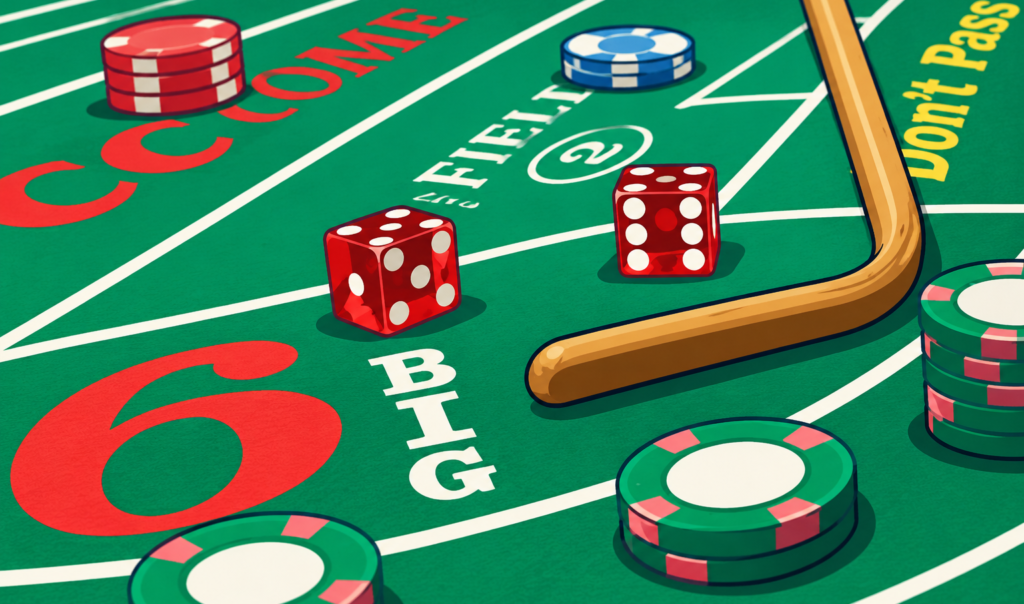
At first glance, craps might seem like a game of chance in its purest form: two dice are thrown, their numbers are added, and fortunes are made or lost according to the result. Yet, beneath the apparent simplicity lies a surprisingly interesting mathematical structure. In fact, craps offers an excellent opportunity to explore several fundamental ideas in probability, including the distribution of sums, conditional probability, sequences of independent events, and expected value.
The game is particularly interesting because the significance of a particular dice total depends on the stage of play. A number that brings good fortune on one roll may become the very number a player wishes to avoid on the next.
Let’s examine the basic rules.
A Game of Two Acts
In a standard game of craps, one player, called the shooter, throws two ordinary six-sided dice. Although several players may place different wagers on the same throw, we will concentrate on the Pass Line bet, one of the most fundamental wagers in the game.
The game begins with what is known as the come-out roll. If the shooter obtains a sum of or , the player wins immediately. These outcomes are called naturals. Conversely, a sum of , , or results in an immediate loss; these are known as craps.
But what happens if neither of these situations occurs?
If the initial throw produces , , , , , or , that number becomes the player’s point. The shooter must then continue rolling the dice until one of two things happens:
- The point is rolled again, in which case the player wins.
- A appears before the point is repeated, in which case the player loses.
Any other result simply means that the game continues12.
Notice the curious role assigned to the number . On the come-out roll, it is a winning outcome; once a point has been established, however, it becomes the losing outcome. The dice haven’t changed, nor have their probabilities, but the rules have transformed what their results mean.
This simple observation is the key to understanding the mathematics of craps.
Why Seven Is Special
Before examining the game itself, let us consider the probability of obtaining each possible sum when two ordinary dice are thrown.
Since each die has six faces, there are
equally likely outcomes. The possible sums range from to , but these eleven numbers are certainly not equally likely. For example, a sum of can only be obtained by rolling a on each die. A sum of is equally restrictive. If, on the other hand, we draw a sample space (see Fig. 1), we can see that a sum of can be obtained in six different ways:
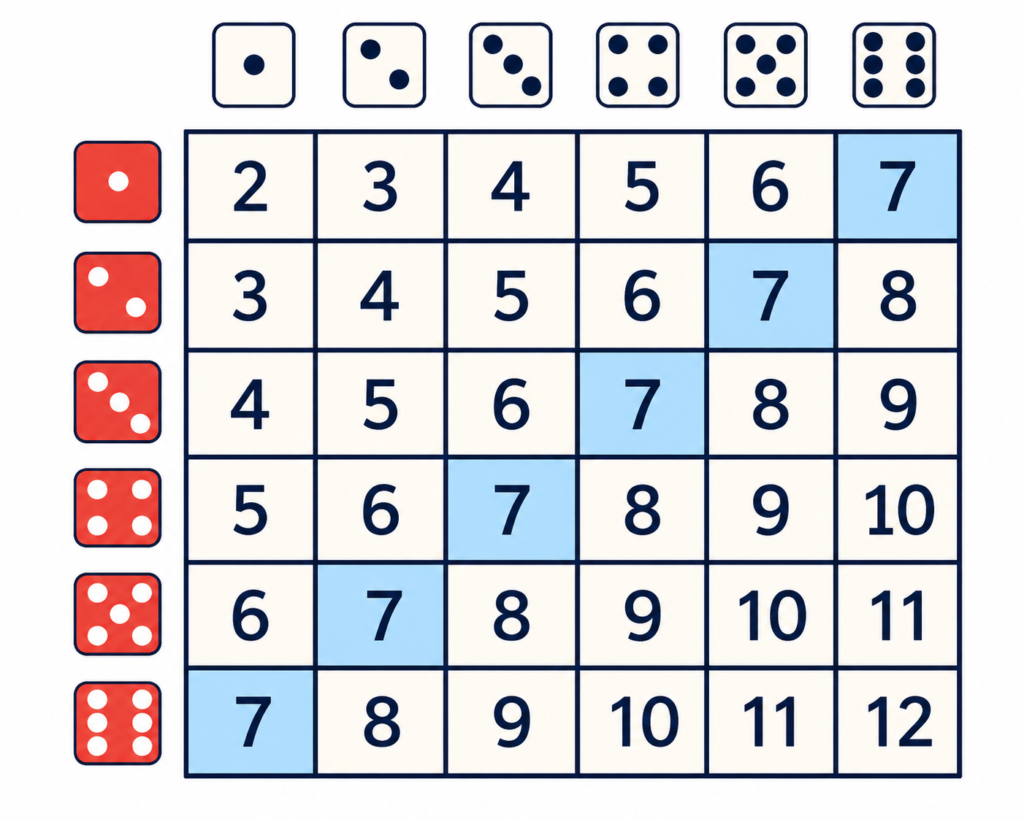
Consequently, is the most likely sum, occurring with probability
The following table summarizes the elegant pattern displayed by these sums:
| Sum | Number of combinations | Probability |
|---|---|---|
| 2 or 12 | 1 | |
| 3 or 11 | 2 | |
| 4 or 10 | 3 | |
| 5 or 9 | 4 | |
| 6 or 8 | 5 | |
| 7 | 6 |
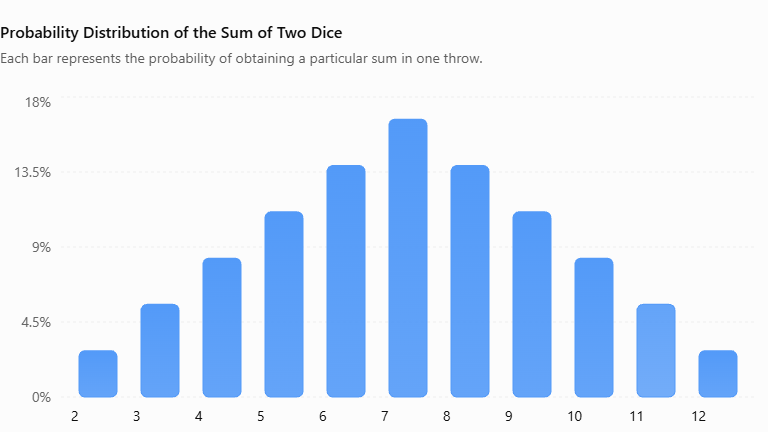
The distribution is symmetric around (See Fig. 2): the probabilities of obtaining and , for instance, are identical, as are those of obtaining and . Moreover, the closer a sum is to , the more combinations can produce it.
This pattern is not merely an interesting curiosity. It determines virtually everything that follows in the game. The unusually high probability of rolling a 7 explains why it is advantageous on the come-out roll but dangerous after a point has been established.
We can now investigate precisely how likely a player is to make his point before rolling a 7.
The Point: A Race Against Seven
Suppose the shooter establishes a point of . There are five combinations that produce a , but six combinations that produce a 7. At first, one might be tempted to conclude that the probability of winning is simply . That would be incorrect, however, because the shooter is not limited to a single additional throw. He may roll the dice several times, and any result other than or leaves the game unresolved.
The relevant question is therefore not whether the next roll produces a , but whether a appears before a . We can simplify the problem by disregarding all outcomes that do not affect the point. Eventually, one of two decisive events must occur: either the point is repeated, or a appears. So this is equivalent to asking for the probability of rolling a given that we’ve rolled either a or a .
This is an application of conditional probability. Remember that is the probability that event occured given that event B occurred, and there is a formula for it:
So, in our example, let A be the event that the sum of the dice is , and let be the event that the sum of the dice is either or . We wish to determine . Then, is simply . Thus, and since five combinations are producing and six producing . Consequently, the probability that the point occurs first is3
The same reasoning applies to every possible point:
| Point | Ways to obtain point | Ways to obtain 7 | Probability of making point first |
|---|---|---|---|
| 4 or 10 | 3 | 6 | |
| 5 or 9 | 4 | 6 | |
| 6 or 8 | 5 | 6 |
An interesting consequence emerges: a point of or gives the player a better chance of winning than a point of or . This is because the former numbers have more possible combinations, bringing them closer in frequency to the dreaded
The argument can be made more rigorous by examining all possible sequences of non-decisive rolls, along with a general counting argument to determine the different ways a sum can be achieved. This leads us naturally to a geometric series and counting technique that will be useful for exploring other variants (e.g., using dodecahedrons as dice instead of cubes), which we will apply in the following calculations.
Let be the sum of the numbers on the faces of two dice. Define the function by the rule: For any given sum ,
Why, then, you may ask, does this function give the correct number of ways in which a sum can be obtained from some dice throw? To answer this question, remember that we wish to count the number of integer pairs with
If , then both and may be at most , which is at most (the upper bound comes from ). In this case, there is no restriction, and the number of solutions is simply (pick ). For example, let , which can be attained in four different ways: .
We will call this our naive count . For , we must subtract the number of invalid solutions in which either or , but not both (if and , then , which is impossible!) from our naive count. If , then may be equal to because .
In other words, the upper bound constraint still applies in addition to the new lower bound. As a result, the number of possible solutions in this case is , inclusive. Similarly, if , the number of possible solutions is simply . Then, we subtract these invalid solutions from to get the expression for all ,
And that is why the function indeed gives the correct count for the number of ways in which a particular sum is made. Why, you may also ask, go to the trouble of making this counting argument when we can make a table summing over all the possible pairs just as we did at the beginning of this article? Well, imagine what would happen if, instead of 6 faces, our dice had , , or more faces; then the brute-force counting would become particularly laborious and impractical (to say the least!).
Now, to determine the overall probability of winning this game, we must add up all the probabilities that contribute to it, i.e., all the ways a given player may win. As stated in the problem, if the player gets the sum or on his first roll, he wins. Then,
Another way to win is by setting a point first (any other sum has occurred on his first roll except , , or ). The probability of setting a point on his first roll is
If a player has set a point, they continue to roll until either a subsequent roll matches their point and wins or they roll a 7 and lose. Let(his point), (lose), and (other sums). After a point has been set, each roll is either decisive, with probabilities of winning or losing, and respectively, or non-decisive, with probability (In which case he must throw the dice again).
For a player to win at all, the first decisive roll must be his point , which can happen on the very next roll, having a probability of , after a non-decisive roll, having a probability of , after two non-decisive rolls, having a probability of , and so forth. Hence,
Then, since , by substitution,
By the general product rule of probability (the conjunction of setting a point first and then winning once that point is matched on any subsequent roll), the total contribution from all possible points is
Consequently, since the events corresponding to the different ways of winning are mutually exclusive, the addition rule of probability gives
A Dodecahedral Game of Craps
So far, we have relied on two familiar cubic dice, each with six faces. Their geometry gives rise to equally likely ordered outcomes and the characteristic symmetric distribution of sums. But is the cube essential to the mathematics?
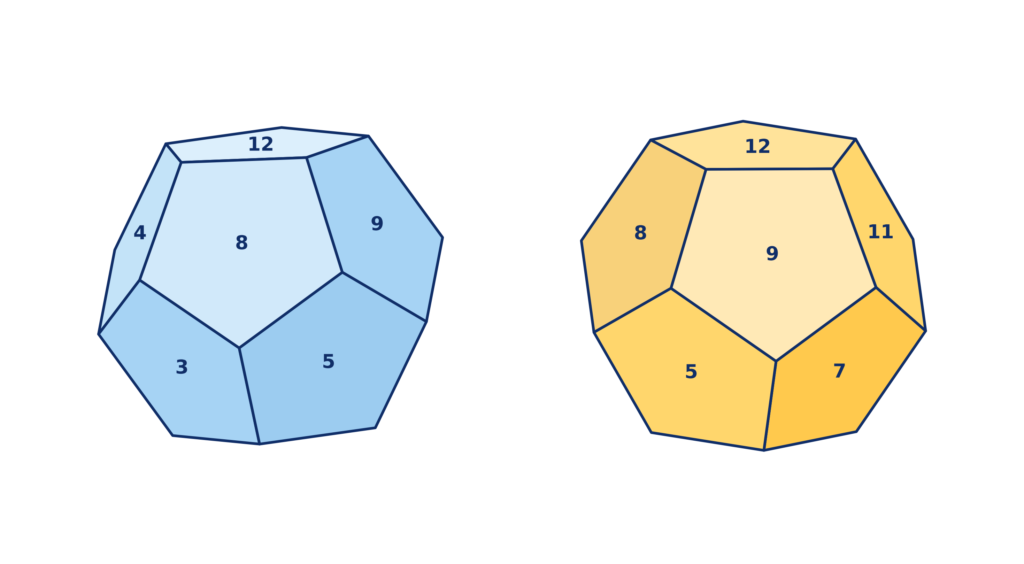
Suppose a modified version of the dice game craps is played with two regular (i.e., perfectly symmetrical) dodecahedra. Each die has its sides numbered from to so that after each throw of the dice, the sum of the numbers on the top two surfaces of the dice would range from to . If a player gets the sum or on his first throw (a natural), he wins. If he gets , , or on his first throw (craps), he loses.
If he gets any other sum (his point), he must throw the dice again. On this or any subsequent throw, the player loses if he gets the sum 13 and wins if he gets his point, but must throw both dice again if any other sum occurs. The player continues until he either wins or loses. To the nearest whole percent, what is the probability at the start of any game that a shooter wins?4
Solution
Reveal solution
There are equally likely outcomes. Suppose is the sum of the two numbers on the top two surfaces of the dice. Define the function by the rule: For any given sum ,5
Now, to determine the overall probability of winning this game, we must add up all the probabilities that contribute to it, i.e., all the ways a given player may win. As stated in the problem, if the player gets the sum or on his first roll, he wins. Then,
Another way to win is by setting a point first (any other sum has occurred on his first roll except , , or . The probability of setting a point on his first roll is therefore
If a point has been set, the player continues to roll until either a subsequent roll matches his point and wins or gets the sum and loses. Let (his point) and (lose).By the result of the introductory problem, the probability in this case is
Then, by the general product rule of probability (the conjunction of setting a point first and then winning once that point is matched on any subsequent roll), the total contribution from all possible points is
Consequently, by the sum rule of probability for mutually exclusive events, the overall probability of winning is the sum of all the aforementioned contributions, that is6,
I don’t know about you, but I definitely wouldn’t play this version!
The House Edge: A Question of Expectations
Knowing the probability of winning a wager is important, but it does not tell us the entire story. After all, winning a bet that pays one dollar is quite different from winning one that pays ten dollars. To evaluate a wager properly, we must consider both the probability of each possible outcome and the corresponding gain or loss.
This brings us to the concept of expected value.
In probability theory, the expected value of a random variable is the weighted average of all its possible values, where each value is weighted according to its probability of occurrence. In other words, it tells us what the average result would be if we could repeat the same experiment a very large number of times. For a Pass Line bet, the player receives an even-money payout: he gains one unit if he wins and loses one unit if he loses. From our previous calculation,
Let represent the player’s net gain from a single wager. Its expected value is therefore
The negative sign is particularly important: it tells us that the wager is unfavorable to the player. On average, the player loses approximately units for every units wagered.
For example, if someone repeatedly places a one-dollar Pass Line bet, the expected loss per resolved wager is approximately cents. Of course, this does not mean that the player will actually lose that amount on every occasion. Individual outcomes may vary considerably; the expected value describes the long-run average, not the result of any particular game.
This small but persistent disadvantage is known as the house edge. In this case, the casino has an advantage of approximately over the player’s initial wager7.
Thus, although the probability of winning a Pass Line bet is remarkably close to one-half, the odds are not quite in the player’s favor. The difference is small enough to be easily overlooked in a single game, but probability has a way of making such differences significant when the experiment is repeated often enough. What, then, would be the house edge for the Dodecahedral Game of Craps?8
References & Further Reading
Technical notes & references
- MGM Resorts International. (n.d.). Guide to craps. https://www.mgmresorts.com/en/gamesense/guide-to-craps.html ↩︎
- Obringer, L. (2004, July 8). How craps works. HowStuffWorks. https://entertainment.howstuffworks.com/craps.htm ↩︎
- This analysis follows closely that of Hoshino, R. (n.d.). Probability of winning at craps. Dalhousie University. https://www.mscs.dal.ca/~hoshino/book/ch20craps.pdf. A brilliant exposition of basic probability applied to this game ↩︎
- Adapted from Hoeflin, R. K. (1997, June). Problem 17 in The Hoeflin Power Test. Retrieved November 11, from http://miyaguchi.4sigma.org/hoeflin/power/power.html ↩︎
- To derive this counting function, the argument is completely analogous to the original problem of Craps at the beginning ↩︎
- Note that we multiply by 2 the whole sum of probabilities of matching one’s point after setting a point because the distribution of sums around the sum 13 is completely symmetrical ↩︎
- Shackleford, M. (2026, August 3). How the house edge for each bet is derived. Wizard of Odds. https://wizardofodds.com/games/craps/appendix/1/ ↩︎
- For a fuller mathematical treatment of craps, we recommend Mark Bollman’s Mathematics of the Big Four Casino Table Games: Blackjack, Baccarat, Craps, & Roulette (2021). ↩︎